
Adam had been living on the streets for 13 years.
At 43 years old, he owned almost nothing. No car. No apartment. No steady job. Everything he possessed fit inside a weathered backpack with a broken zipper that he secured with a safety pin. But there was one thing he still carried with him that no one could see.
His pride.
He had one rule — he never begged.
People in town knew him. Not well enough to invite him into their homes, but well enough to recognize him.
Adam was the man who would offer to carry groceries to the car for five dollars. The one who shoveled snow from driveways in the winter and raked leaves in the fall.
He cleaned gutters, hauled trash, painted fences, and stacked firewood. If someone needed help moving a couch up three flights of stairs, Adam was the first to raise his hand.
“I don’t want charity,” he would say when someone tried to slip him money out of pity. “Give me something to do.”
Most people respected that.
Some didn’t.
“You’re too proud for your own good,” one shop owner had told him once.
Adam had simply smiled. “Pride’s the only thing I’ve got left.”
He survived with dignity.
That evening had turned colder than he expected. The wind cut through his thin jacket as he walked the quiet streets. The sky was a dull gray, threatening rain. He had earned just enough that day to buy a sandwich and a bottle of water. His stomach was full, but his bones ached.
He needed shelter.
The abandoned house on Willow Street had become his occasional refuge. It was a crumbling two-story place with boarded windows and peeling paint. The front door hung crooked on its hinges, but it still closed well enough to block the worst of the wind. No one had lived there for years.
Adam stepped inside and exhaled slowly.
“Home sweet home,” he muttered to himself, brushing dust from a corner of the living room.
He laid his backpack down and lowered himself onto the dusty wooden floor. The house smelled of mildew and old wood, but it was dry. That was enough.
As he stretched out, something caught his attention.
A faint unevenness beneath his shoulder. He shifted and ran his hand across the floorboards.
One felt loose.
Adam frowned.
He pushed himself up and examined it more closely. The board lifted slightly at one end. Curiosity tugged at him. He had spent enough nights in abandoned places to know that sometimes people hid things.
He hesitated.
“This isn’t your business,” he murmured.
But he was already sliding his fingers beneath the edge.
With a firm pull, he lifted the loose floorboard.
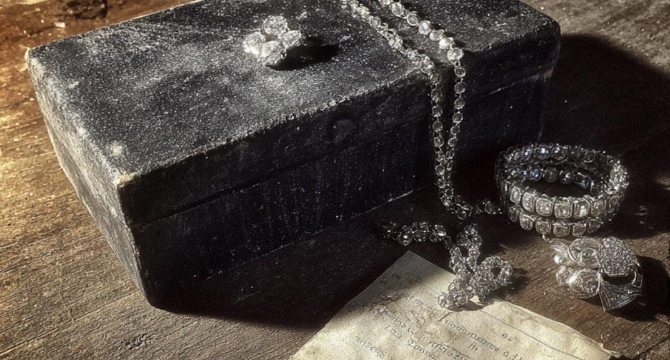
Underneath was a small jewelry box.
Adam froze.
It was wooden, dark, and polished, surprisingly untouched by dust. He stared at it for several seconds, his pulse quickening. Slowly, almost afraid it might vanish, he lifted it out.
The latch clicked softly when he opened it.
Inside was a collection of valuables — rings, necklaces, gold pieces that could change his life overnight.
The metal glinted faintly in the dim light filtering through the cracked window. A heavy gold chain. A diamond ring. Several delicate bracelets.
Adam swallowed hard.
He did not need to be an expert to know this was worth a lot. More money than he had seen in over a decade. Enough for rent. Enough for new clothes. Enough for a fresh start.
His hands trembled.
For a moment, an image flashed in his mind: a small apartment with clean sheets, a hot shower, a steady job. No more sleeping on floors. No more pretending not to hear insults.
“This is it,” he whispered.
But then he noticed something else inside the box.
A folded note.
Adam’s chest tightened as he unfolded it carefully.
The handwriting was rushed, slightly shaky.
“Give this to Kylie if anything happens to me. This will save her life. She doesn’t have much time.”
There was an address written below.
The room suddenly felt smaller.
He read the note again. And again.
Kylie.
He stared at the gold pieces.
The weight of temptation pressed heavily on him. No one knew he was here. No one knew about the box. He could close it, slip it into his backpack, and walk away.
Thirteen years on the streets.
Thirteen winters.
Thirteen summers of blistering heat.
He imagined handing the jewelry to a pawnshop owner. Imagined cash in his hands. A motel room. A bed.
But the words echoed louder.
“This will save her life. She doesn’t have much time.”
Adam shut the jewelry box and stood up abruptly, as if afraid he might change his mind if he lingered.
He paced the dusty room.
“You don’t know her,” he told himself.
Yet something inside him stirred. A memory he had buried for years. A hospital hallway. A beeping machine. A voice telling him it was too late. He clenched his jaw.
He knew what it felt like to run out of time.
Without allowing himself another second to reconsider, Adam tucked the jewelry box under his arm and grabbed his backpack.
He didn’t hesitate. Clutching the box, he ran across town to the address in the note.
His lungs burned as he moved through the dark streets.
Cars passed, headlights flashing briefly across his face. He must have looked wild, sprinting with a wooden box pressed to his chest.
The address led him to a small, modest house in a quiet neighborhood. The porch light was on. A ramp had been built beside the front steps.
Adam slowed, trying to catch his breath. His heart pounded for reasons that had nothing to do with running.
He walked up the ramp and knocked.
For a moment, nothing happened.
Then footsteps approached from inside.
The door opened.
Adam’s breath caught.
A little girl in a wheelchair looked up at him.
She could not have been older than eight. Her dark hair was pulled into two uneven pigtails. A thin blanket covered her legs. Her eyes were wide, curious, but tired in a way no child’s eyes should be.
She studied him without fear.
Adam realized what he must look like. Unshaven. Worn jacket. Dirt on his hands.
His voice came out hoarse, but steady.
“Are you Kylie?” he asked.
The little girl blinked up at him.
“Yes,” she answered softly. “I’m Kylie.”
Her voice was small but steady. She rested her hands on the wheels of her chair as if bracing herself. Adam felt something twist inside his chest.
Before he could speak again, a woman hurried into view behind her. She looked to be in her mid-30s, her brown hair pulled back in a loose ponytail. There were dark circles under her eyes, the kind carved by sleepless nights.
“Kylie, who is it?” the woman asked, her tone protective.
Adam swallowed. “I’m sorry to show up like this,” he began carefully. “I found something. There was a note.”
He held up the small wooden jewelry box with trembling hands. “It said, ‘Give this to Kylie if anything happens to me. This will save her life. She doesn’t have much time.’ There was this address written below.”
The woman’s face drained of color.
“Where did you get that?” she whispered.
“In an abandoned house on Willow Street,” Adam replied. “Under a loose floorboard.”
Kylie’s fingers tightened on her blanket. “That was my grandma’s house,” she said quietly.
The woman placed a hand on Kylie’s shoulder. “I’m her mother, Laura,” she told Adam. Her eyes flickered from his worn jacket to the box in his hands. “May we see it?”
Adam nodded and stepped inside. The house was warm, and the scent of soup lingered in the air. He suddenly became aware of the dirt on his boots and hesitated near the doorway.
“It’s fine,” Laura said gently. “Please.”
He handed her the jewelry box.
Laura opened it, and the gold pieces caught the light of the hallway lamp. She gasped, covering her mouth with one hand.
“Oh my God,” she breathed.
Kylie leaned forward in her wheelchair. “Is it what I think it is?” she asked.
Laura nodded, tears already forming. “It’s Mom’s jewelry. She sold almost everything when Kylie got sick. But she told me once that she kept a few pieces, just in case.”
Adam shifted uncomfortably. “The note said this would save her life.”
Laura folded the paper with shaking fingers.
“Kylie needs surgery,” she explained. “A specialist in another state agreed to take her case. But the cost…” Her voice cracked. “Insurance won’t cover all of it. We’ve been short.”
Kylie looked down at her hands. “Mom said we’d figure it out.”
Adam studied the girl more closely now. He noticed how thin her arms were, how the wheelchair seemed both too large and too permanent for someone her age.
“What’s wrong?” he asked softly.
“A degenerative nerve condition,” Laura replied. “It’s getting worse. If we don’t act soon, she could lose more function. The surgery isn’t a guarantee, but it’s her best chance.”
Silence settled between them.
Adam felt the weight of the room pressing in on him. He had carried that box across town without fully understanding what it meant. Now he did.
Laura suddenly looked up at him, suspicion flickering through her grief. “Why bring it here?” she asked. “You could have kept it. No one would have known.”
Adam met her gaze.
“I’ve been living on the streets for 13 years,” he said quietly. “I’ve thought about what I’d do if I ever got a second chance. When I opened that box, I knew it could change my life overnight.”
He paused, choosing his words carefully.
“But the note said she doesn’t have much time.”
Kylie’s eyes filled with tears. “You ran all the way here?” she asked.
He gave a small nod. “I didn’t want to waste a minute.”
Laura closed the jewelry box and pressed it against her chest. “You have no idea what this means,” she whispered.
Adam looked down at his hands. They were calloused and rough, marked by years of labor. “I might,” he said.
Laura studied him. “What’s your name?”
“Adam.”
“Well, Adam,” she repeated softly. “Thank you.”
He shifted awkwardly.
Gratitude made him uneasy. “You should get it appraised,” he said. “Sell whatever you need.”
Laura wiped her eyes. “I will. First thing tomorrow.”
Kylie rolled her chair closer to him. “Grandma always said heroes don’t wear capes. They just do the right thing.”
Adam let out a breath that almost sounded like a laugh. “I’m no hero.”
But as he looked at her, something long buried rose to the surface.
Thirteen years ago, before the streets, before the pride that was all he had left, Adam had been a husband and a father.
His daughter, Mia, had been six when she was diagnosed with leukemia.
He had worked double shifts at a warehouse, sold his car, and emptied his savings. It had not been enough. The treatment options were limited. The costs were crushing.
He remembered sitting beside her hospital bed, holding her small hand as machines beeped around them. He remembered promising her that he would fix everything.
He had not been able to.
After Mia passed away, his marriage crumbled under the weight of grief. He lost his job. Bills piled up. One mistake led to another. Pride kept him from asking for help until it was too late.
He had failed his own child.
Standing in Laura’s hallway, Adam realized something with painful clarity.
He could not save Mia.
But maybe he had just helped save Kylie.
“Are you okay?” Laura asked gently, noticing the change in his expression.
He blinked and nodded. “Yeah. Just thinking.”
Kylie reached out her hand. After a brief hesitation, Adam took it carefully. Her grip was weak but warm.
“I’m glad you found it,” she said.
“So am I,” he replied.
Laura cleared her throat. “Adam, please stay for dinner. It’s just soup, but…”
He shook his head at first, instinctively ready to refuse. Accepting kindness had always felt dangerous, like it might chip away at the only armor he had left.
But Kylie looked at him expectantly.
“It’s chicken noodle,” she added. “My favorite.”
He hesitated, then gave a small nod. “Okay. Thank you.”
They sat at the kitchen table together. Adam ate slowly, almost shyly, as if afraid someone might change their mind. The warmth of the food spread through him in a way that felt unfamiliar.
They talked.
Kylie told him about her favorite books and how she loved drawing butterflies. Laura shared stories about her mother, about the abandoned house on Willow Street, and the memories it held.
For the first time in years, Adam felt like he belonged somewhere.
When he finally stood to leave, Laura walked him to the door.
“We’ll never forget this,” she said. “And when Kylie gets through her surgery, I hope you’ll come see her.”
He nodded. “I’d like that.”
Kylie called out from the hallway, “Bye, Adam!”
He turned and waved. “Bye, Kylie. Take care.”
The night air felt different as he stepped outside.
Still cold, but lighter somehow.
He had walked into that abandoned house thinking he might find shelter.
Instead, he had found redemption.
Adam adjusted the straps of his worn backpack and began walking down the quiet street. For the first time in 13 years, the future did not feel like something he had lost.
It felt like something he might still earn.
 admin
admin