
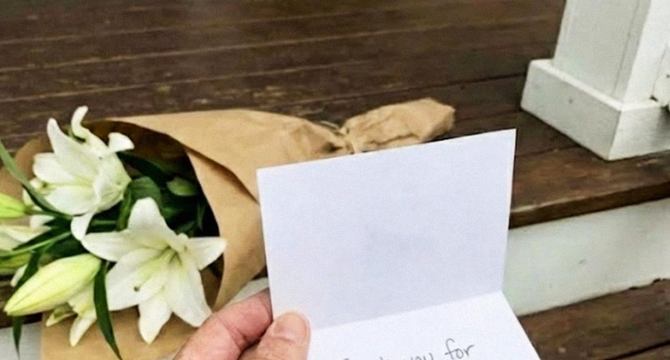
Every Sunday at noon, flowers appeared on my porch.
The first time, I assumed a delivery driver had messed up. Wrong house, wrong mom, wrong everything.
A small bunch of white lilies sat by the mat with a folded card tucked inside.
The next Sunday, more flowers came.
“Thank you for raising my son. I’ll always be grateful.”
No name. No number. Nothing else.
I had one son. Noah. Twenty-four years old, finishing grad school, too smart for his own good.
I had carried him. I had pushed through the pain and the panic and the prayers that felt like bargaining.
So who was thanking me for raising their son?
The next Sunday, more flowers came.
I stared at the flowers in my kitchen sink.
Different bouquet, same handwriting, same message, like it was a ritual.
I sent Noah a picture. “Is this you being weird?”
He called immediately. “Mom, no. That’s creepy.”
“I thought it was a mistake,” I said. “But it’s the second week.”
“Then stop touching them,” he said. “Call someone. Put up a camera.”
I stared at the flowers in my kitchen sink.
“If she shows up, you don’t go out alone.”
“They’re just flowers,” I told him, but my voice did not sound sure.
By the third Sunday, I stopped telling myself it was harmless.
On the fourth Sunday, I waited.
Noah was home that weekend, and he hovered behind me.
“If she shows up, you don’t go out alone,” he said.
“I’m not helpless,” I replied.
She turned and looked right at me.
“I know,” he said. “But I’m still allowed to worry.”
At noon, a woman walked up my driveway.
Mid-fifties. Neat hair. Soft sweater. She carried a bouquet like it was fragile.
I opened the door before she could leave.
“Excuse me,” I said, louder than I meant.
She turned and looked right at me, calm and sad at the same time.
“You keep thanking me. For what?”
“I’m sorry,” she said.
“Why do you keep leaving these?” I demanded. “Who are you?”
She swallowed. “My name is Elaine.”
Noah stepped into the doorway behind me.
“For what?” I said, holding up the note. “You keep thanking me. For what?”
Elaine looked at the flowers. “For loving him.”
Elaine flinched at his voice but kept her eyes on mine.
My heart thudded. “He’s my son.”
Elaine’s eyes filled. She nodded once, like she agreed.
Then she said, very quietly, “Ask Mark what happened the day Noah was born.”
Noah leaned forward. “Lady, what are you talking about?”
Elaine flinched at his voice but kept her eyes on mine.
“I didn’t come to take anything,” she whispered. “I just… couldn’t stay quiet anymore.”
Then she turned and walked down my driveway.
“Quiet about what?” I asked.
Elaine’s lips trembled. “The truth.”
She stepped backward, already retreating.
“Elaine!” I called.
She shook her head once. “Please. Ask him.”
Then she turned and walked down my driveway, shoulders stiff like she was holding herself together by force.
I called Mark with shaking hands.
Noah looked at me, pale. “Mom. What was that?”
I had no answer that made sense.
All I had was an old memory, foggy and bright at the edges.
Ambulance lights. A mask. Someone yelling numbers. A hard pull of fear in my chest.
Then nothing.
I called Mark with shaking hands.
“You had a difficult delivery.”
He answered on the second ring. “Anna—”
“Elaine came to my house,” I said.
Silence.
“What happened when Noah was born?” I asked.
Mark exhaled slowly. “You had a difficult delivery.”
“Don’t,” I said. “Not that. The real thing. The thing you don’t want to say.”
Mark’s tone hardened.
He lowered his voice. “Where is Noah?”
“Here,” I said. “And he’s listening.”
Noah took the phone from my hand. “Dad, who is Elaine?”
Mark went quiet like he had stepped off a ledge.
“Noah,” Mark said finally, “give the phone back.”
“No,” Noah said, voice tight. “Talk.”
He showed up 40 minutes later.
Mark’s tone hardened.
“This is not your business.”
Noah stared at the phone. “My birth isn’t my business?”
I took it back. “Come over,” I said to Mark. “Now.”
“I can’t,” he said.
“You can,” I replied. “Or you can lose me for good.”
Mark tried a weak smile that died fast.
He showed up 40 minutes later.
He stood in my doorway like he didn’t know if he was allowed inside.
Noah sat on the armchair, elbows on his knees, eyes locked on his dad.
I stayed standing because sitting felt like giving up.
Mark tried a weak smile that died fast.
“Tell me,” I said.
The room disappeared around me.
He looked at Noah. Then at me. Then at the floor.
“Anna,” he began, voice rough, “you were unconscious. You were bleeding. They were trying to save you.”
My throat tightened. “What about the baby?”
Mark’s eyes filled. “The baby was stillborn.”
The room disappeared around me.
I stared at him, waiting for him to laugh and say it was a sick joke.
I felt a new grief crack open inside me.
He didn’t.
“No,” I whispered.
Mark nodded once, crying now. “I’m sorry.”
Noah stood up so hard the chair scraped. “Dad, what the hell?”
Mark held up his hands like he wanted to stop a train with his palms.
“Listen,” he said. “Please. Just listen.”
Mark looked at him, shame flooding his face.
I felt a new grief crack open inside me, something sharp and old.
“A stillbirth isn’t something you forget,” I said, voice shaking. “How did I not know?”
Mark’s face crumpled. “Because I didn’t tell you.”
I blinked. “Why?”
Mark swallowed. “Because they offered something. In the chaos. A social worker. The doctor.”
Noah’s eyes narrowed. “Offered what?”
Mark opened his eyes, red and wet.
Mark looked at him, shame flooding his face. “A baby.”
Silence hit us like a slammed door.
I felt my knees threaten to fold.
“Noah is right there,” I said, my voice turning hard. “What do you mean, a baby?”
Mark squeezed his eyes shut. “Elaine had just delivered. She was alone. She was scared. She’d been talking about adoption.”
Noah’s voice went hoarse. “Dad.”
Noah stared at him like he was seeing a stranger.
Mark opened his eyes, red and wet. “They told me you wouldn’t survive losing another baby. Not after the miscarriages. Not after the depression.”
My jaw clenched. “You didn’t get to decide that.”
“I know,” he whispered. “I know.”
Noah stared at him like he was seeing a stranger. “So I’m… adopted.”
Mark nodded.
“You’re my son.”
Noah laughed once, broken. “Okay. Sure.”
“You let me call you Dad.”
Mark flinched. “I was your dad.”
Noah’s eyes flashed. “You’re a liar.”
I turned to Noah, my heart splitting.
“You’re my son,” I said quickly. “Noah, listen to me—”
“They said you would never have to know.”
He looked at me with tears in his eyes. “Did you know?”
“No,” I said, just as fast. “I swear to you. I did not know.”
Noah’s breath hitched. “So you thought I was—”
“I thought you were my biological baby,” I said, voice cracking. “I thought you were my miracle.”
Mark wiped his face with his sleeve like a kid.
“I signed papers,” he said. “They said it could be sealed. They said you would never have to know.”
“Who am I to either of you?”
“And my baby?” I whispered. The words came out small.
Mark’s face twisted. “He died, Anna.”
I pressed a hand to my mouth.
A grief I had never been allowed to feel flooded in, heavy and hot.
Noah stood there shaking, caught between us.
“So who am I?” he asked. “Who am I to either of you?”
We did DNA tests that week.
I stepped toward him. He didn’t move away, but he didn’t come closer either.
“You are my son,” I said. “That’s not negotiable.”
He stared at me. “But it’s not by blood.”
“It doesn’t have to be,” I said, but my voice wobbled.
Noah looked down, then up, eyes glassy. “I need proof.”
I nodded. “We’ll get it.”
I opened the email alone at my kitchen table.
We did DNA tests that week.
I told myself I was bracing for it, but I wasn’t.
When the results came, I opened the email alone at my kitchen table.
No match.
The world did not explode. Nothing really even shifted. Noah was still mine.
When I showed Noah, he stared at the screen for a long time.
That Sunday, I waited on the porch.
Then he whispered, “So I’m not yours.”
I grabbed his hand. “You are mine.”
He let me hold on, but his fingers were stiff.
He swallowed hard. “I love you. That’s the part that hurts. I love you and I’m still lost.”
“I know,” I whispered. “I’m lost too.”
That Sunday, I waited on the porch.
“We did the test.”
I didn’t want Elaine to be a shadow anymore. I wanted the truth to have a face I could speak to.
At noon, she walked up with pale pink roses.
She stopped when she saw me standing outside.
“You came,” she said, voice trembling.
“I did,” I replied. “We did the test.”
Elaine’s shoulders sagged. She nodded like she already knew.
“You’re my biological mom.”
Noah opened the door behind me and stepped out.
Elaine’s breath caught like she was drowning.
Noah stared at her, face tight. “You’re Elaine.”
She nodded, tears spilling. “Yes.”
He swallowed. “You’re my biological mom.”
Elaine pressed a hand to her chest. “Yes.”
“Why now?”
Noah let out a short, bitter laugh. “Okay. Sure.”
He turned to me. “Mom, you just found out?”
“Days ago,” I said. “I was going to tell you. I wanted to do it right.”
Noah stared at my face, searching. Then he nodded once, like he believed me.
He turned back to Elaine. “Why now?”
Elaine’s voice shook. “Because I’m sick.”
Noah’s jaw clenched.
Noah blinked. “Sick how?”
Elaine inhaled and whispered, “Cancer. Late-stage.”
The porch went silent except for the distant sound of a lawn mower.
Elaine wiped her face. “I didn’t come to take you,” she said quickly. “I didn’t come to ruin your life. I came to thank her.”
She nodded toward me, eyes shining. “She gave you what I couldn’t. Love. Stability. A home.”
Noah’s jaw clenched. “And you watched us online.”
Elaine nodded, sobbing softly.
Elaine flinched. “Yes. I’m ashamed. I was too scared to show up. I thought she knew. I thought it was an open adoption at first.”
She shook her head, voice breaking. “Then they told me it was closed. No contact. No updates. Nothing.”
Noah stared at the roses. “So the flowers were… what? Your guilt?”
Elaine swallowed. “My gratitude. My apology. My last chance to say something without demanding anything.”
Noah’s eyes filled. “You don’t get to drop this on me and then say you want nothing.”
Elaine nodded, sobbing softly. “You’re right.”
Noah wiped his face with his sleeve.
She took a shaky breath. “I want you to know I loved you. I want you to know I regretted it. And I want to ask… if you’d ever talk to me, before I can’t.”
Noah looked at me like he was a kid again, asking permission without words.
I forced my voice steady. “It’s your choice,” I said. “Whatever you decide, I am here.”
Noah wiped his face with his sleeve.
“Not today,” he said, voice breaking. “I can’t. Not today.”
He stared at the street like it might explain everything.
Elaine nodded fast. “Of course. I’m sorry. I’m so sorry.”
Noah glanced at the roses. “You can leave those.”
Elaine gave a small, wet smile. “I will.”
After she left, Noah sank onto the porch step.
I sat beside him, close enough that our shoulders touched.
He stared at the street like it might explain everything.
I reached for his hand.
“Mom,” he whispered, “did you love me the moment you saw me?”
“Yes,” I said.
He swallowed hard. “Do you think she loved me too?”
“I do,” I said. “I think she always did.”
Noah’s voice turned thin. “Then why does it feel like I’m the only one paying for what they did?”
I reached for his hand.
We stayed there until the sun shifted.
“Because you’re the one who has to live forward from it,” I said softly. “But you’re not doing it alone.”
He squeezed my fingers, finally.
“Okay,” he whispered. “Together.”
I nodded, breathing through the ache.
We stayed there until the sun shifted, the roses on the rail catching the light like they were trying to be something other than a wound.
 admin
admin