
I never expected that Tuesday to be anything more than a regular day. My coworker, Diane, had gone in for knee surgery the week before, and I had been meaning to check on her ever since.
After my lunch break, I figured I had just enough time to swing by the hospital, drop off the flowers I had picked up at the gas station, and make it back to the office before my 3 p.m. call.
Diane was in good spirits when I got there.
She was already making jokes about the hospital food and complaining that her TV remote only had three working buttons. We laughed and chatted for about 40 minutes, and by the time I kissed her on the cheek and said goodbye, I felt warm and light. It was exactly the kind of visit that reminds you how much you love the people in your life.
On my way out, I remembered I hadn’t had anything to drink since that morning. I spotted a sign for a coffee machine down the hallway and made a turn.
The corridor was quiet, and my heels clicked against the linoleum floor as I walked.
I was already thinking about whether to get black coffee or try my luck with the hot chocolate button.
That’s when I felt something unusual.
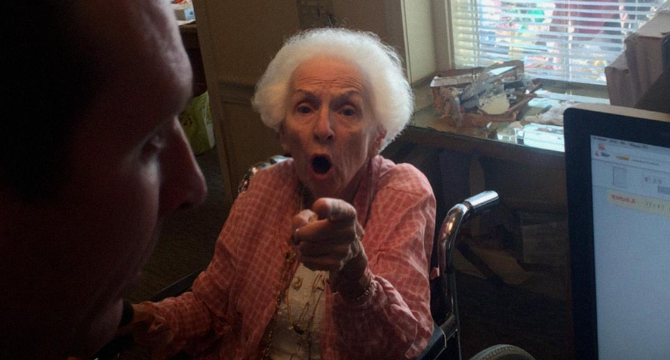
A hand closed around mine, firm and urgent. I stopped walking and turned around. An elderly woman sat in a wheelchair just a foot away from me, and her eyes — pale blue and wide — were filled with something I can only describe as pure, breathless shock.
She was trembling slightly, her thin fingers gripping my hand as if letting go would mean losing something she had spent years looking for.
“Anna,” she whispered. “Anna, it’s you! Where were you?”
“I’m sorry,” I said gently, trying to loosen her grip. “I’m not Anna.”
But she shook her head slowly, her eyes never leaving my face.
“No… no,” she murmured. “I know it’s you, Anna.”
A nurse appeared beside her almost immediately, stepping out from a room across the hall. She looked at me with an apologetic expression and placed a gentle hand on the woman’s shoulder.
“I’m so sorry,” the nurse said. “She sometimes confuses people. It happens.”
“It’s all right,” I said, because what else do you say? But the woman’s grip hadn’t loosened one bit. She was still studying my face. Her eyes moved across my features like she was reading something written there a long time ago.
“How can this be possible?” she whispered, more to herself than to me.
I stood very still. Something in her voice made me not want to pull away.
“Could I ask you for a favor, dear?” she said after a long moment. Her voice was soft, but there was quiet urgency underneath it. “Could you come to my place tonight? I want to show you something.”
Every sensible part of me knew the answer should be no.
She was a stranger, this was a hospital, and the nurse had just explained that she confused people. Yet, something about the way she looked at me made it impossible to walk away.
“Okay,” I heard myself say. “Sure. I’ll come.”
The nurse gave me a long look, and I could tell she wanted to say something. But the woman — she told me her name was Laura — had already relaxed her grip. She let the nurse take over, but her eyes stayed on me the entire time, as if she was afraid I’d disappear the moment she looked away.
After I said a second goodbye to Diane, I drove Laura home.
She lived at the edge of the town in a small, modest house surrounded by old oak trees. The drive was quiet.
She sat in the passenger seat with her hands folded in her lap and her gaze fixed on the road ahead. The air between us felt heavy with something unspoken. I told myself it was nothing. Just a kind gesture to a lonely old woman. That’s all this was.
I almost believed it.
Laura’s house was the kind of place that held its memories close.
Every surface had something on it, like framed photographs, ceramic figurines, and stacks of paperback books with cracked spines. The wallpaper was faded, the furniture a little worn, but it was clear that someone had loved this home for a very long time.
“Thank you for bringing me home,” Laura said as she settled her walker in the hallway. “And for coming. I know this must seem very strange to you.”
“It’s fine,” I told her, and I meant it. “What is it you wanted to show me?”
She looked at me for a moment, then tilted her head toward the staircase. “It’s in the attic. Can you manage the stairs? I’ll need a minute with this old body of mine.”
She wasn’t kidding. It took us a good while to get up to the attic, between her slow steps and my attempts to help without being overbearing.
But when we finally got there, I forgot all about the effort it had taken.
The attic was full of boxes stacked along every wall, old lamps, and rolled-up rugs.
Laura moved with quiet purpose toward a particular box in the corner. She opened it and reached inside, and when she straightened up, she was holding a photo album. The cover was dark blue, its edges worn soft with age.
She held it for a moment without opening it. Then she turned it toward me.
I took it, opened it to the first page, and my breath left my body.
The young woman in the photographs looked exactly like me. Not somewhat like me. Not a passing resemblance. Exactly.
She had the same eyes and the same wide smile. She even had the same small birthmark on the left side of the neck. She looked back at me from faded photos across what appeared to be decades of her life — as a teenager, as a young woman in her 20s, laughing at the camera, standing in front of a car, sitting cross-legged on a porch.
Beneath each photograph, in careful handwriting, was a single name, Anna.
My pulse hammered in my chest. I looked up at Laura. “Who is this?”
“That’s my daughter,” she said quietly. “Her name is Anna. She left home 30 years ago, not long after she gave birth. But… she never came back.”
“Laura,” I said carefully, “this is a remarkable resemblance, but—”
“There’s more,” she said. She reached back into the box and pulled out a folded paper. Then another. She spread them on the top of an old trunk and smoothed them with her hands. The first was a birth certificate. The second was a hospital record.
Both bore a date that made my hands go cold.
“That’s my birthday,” I said.
“I know,” Laura nodded.
“And the town listed on this record—” I stopped. My mouth had gone dry. I recognized the name of that town. It was the same town my adoptive parents had always told me I came from. The same town they’d said I was left at as a baby.
They told me that my birth family never left any names or records. They just left me in a small orphanage, and I was a little girl with no story.
I had always told myself it didn’t bother me and that I was fine not knowing where I came from. I had a good life and a loving family.
I didn’t need more than that.
But standing in that dusty attic with my own face staring up at me from a photo album, with a birth date and a birthplace lined up like answers to questions I had never let myself ask, I realized that part of me had been waiting for this moment my entire life.
Laura looked at me. Her eyes were full of tears, but her voice was steady.
“I’ve been searching for you for 30 years,” she said.
We sat down on two old chairs that Laura pulled from the corner of the attic, and she talked.
She talked for a long time, and I listened to every word.
Anna had been young, barely 20, when she found out she was pregnant. She and the baby’s father had already separated. She was scared and overwhelmed, and by the time the baby was born, she had convinced herself she had no choice.
She left the hospital two days after giving birth and just disappeared from Laura’s life.
“She was so ashamed,” Laura told me. “She wasn’t a bad girl. She was just a frightened one. I tried to find her… I went to the hospital, I asked about the baby, and I even hired someone to look. But by the time I had any information, you had already been transferred. The trail went cold.”
“What did they tell you?” I asked.
“They told me the child had been placed with an orphanage and then adopted,” she said. “They gave me nothing else. No names, no location, nothing. Rules, they said.” She shook her head slowly. “I never stopped looking. I searched for you every single year. Every time I thought I had a lead, it came to nothing.”
I sat with that for a moment.
Outside, the sun was starting to go down, and the light coming through the small attic window had turned the color of honey.
I thought about my adoptive parents.
They were good, steady people who had given me every reason to feel loved and wanted.
I thought about every birthday I had spent quietly wondering where I had really come from. And I thought about this woman in front of me, who had been walking through her life for three decades with a hole in it the exact shape of me.
To be honest, I was angry too.
Why hadn’t my mother kept me? Why had she walked away without looking back? What had I not been worth? Those questions surfaced fast, and they hurt in that deep, particular way that only abandoned people ever really understand.
“Where is she?” I asked. “Where’s Anna now?”
“I don’t know,” Laura admitted. “I haven’t seen her in 30 years. I don’t even know if she’s still alive.”
That hit me harder than I expected. The idea of finding out I had a mother, only to learn she might be gone… it was a lot to carry in a single evening.
“I’m so sorry,” Laura said then. “Not for what Anna did. She has to own that herself. I’m sorry I didn’t find you sooner. All those years, you were out there somewhere, and I didn’t get to you in time.”
“You found me today,” I said.
And somehow, that felt like enough for the moment.
We stayed in that attic until the light was completely gone, and then we moved downstairs. Laura made tea, and we sat at her kitchen table and kept talking.
She told me stories about Anna as a little girl, like how she used to collect rocks and name them, and how she was afraid of thunderstorms. And with every detail, I felt something strange and overwhelming happening inside me.
It was a kind of recognition I had no language for.
Before I left, Laura reached across the table and took my hand.
“Would you be willing to take a DNA test?” she asked. “I know what I see when I look at you. But I want you to have proof. Real proof, so you never have to doubt it.”
“Yes,” I said. It came out immediately, without hesitation. “I want that too.”
She smiled then, and for just a second, I thought I could see it.
A trace of something familiar in the curve of her mouth.
Maybe it was just my imagination. Maybe I was already looking for things that weren’t there. Or maybe the body always recognizes its own.
I walked into that hospital that morning to visit a coworker, and I walked out with a grandmother. And maybe, tucked somewhere in the years ahead, the beginning of my real story was waiting too.
 admin
admin