
I was 23 years old the first time I saw him.
Every year, on the same day, I visit my mother’s grave.
It is the one promise I have never broken.
No matter what is happening in my life, no matter where I am, I show up. In the rain. In the wind. In the kind of early morning chill that seeps into my bones and settles there.
She raised me alone, and growing up, it was always just the two of us.
My mom, Ruth, used to say that we were “a team of two against the world.” She would grin when she said it, even on days when I could tell the world had won.
She worked twelve-hour shifts as a nurse, coming home with aching feet and tired eyes. But exhaustion never stopped her. She cooked dinner. She listened to my stories about school. And when I was small, she would gently braid my hair at bedtime, like there was nowhere else she needed to be.
I never knew my father.
Not even his name. My mom told me he died when I was born and refused to say anything more.
I stopped asking years ago.
I remember the last time I brought it up. I was 13 and angry at everything.
“Why won’t you just tell me about him?” I snapped across our tiny kitchen table.
She went still. Not mad. Not defensive. Just… still.
“He died when you were born,” she said quietly. “That’s all you need to know.”
“That’s not fair.”
Her voice trembled, but she held my gaze.
“Some things aren’t meant to be dug up, Paige.”
I didn’t understand then.
I thought she was protecting herself. I never imagined she might have been protecting me.
After that night, I stopped asking.
It was easier to accept a dead man than an unknown one.
When Mom passed away five years ago, it felt like someone had pulled the ground from under me. Cancer. Fast and cruel. She had hidden her symptoms until she couldn’t anymore. By the time the doctors said the word out loud, it was already too late.
On her last night in the hospital, she squeezed my hand with surprising strength.
“Promise me something,” she whispered.
“Anything.”
“Don’t let yourself be alone in this world.”
I laughed through tears. “You’re not leaving me.”
She gave me that look. The one that said she knew more than I did.
“Promise me.”
“I promise.”
Every year, on the anniversary of her death, I visit her grave.
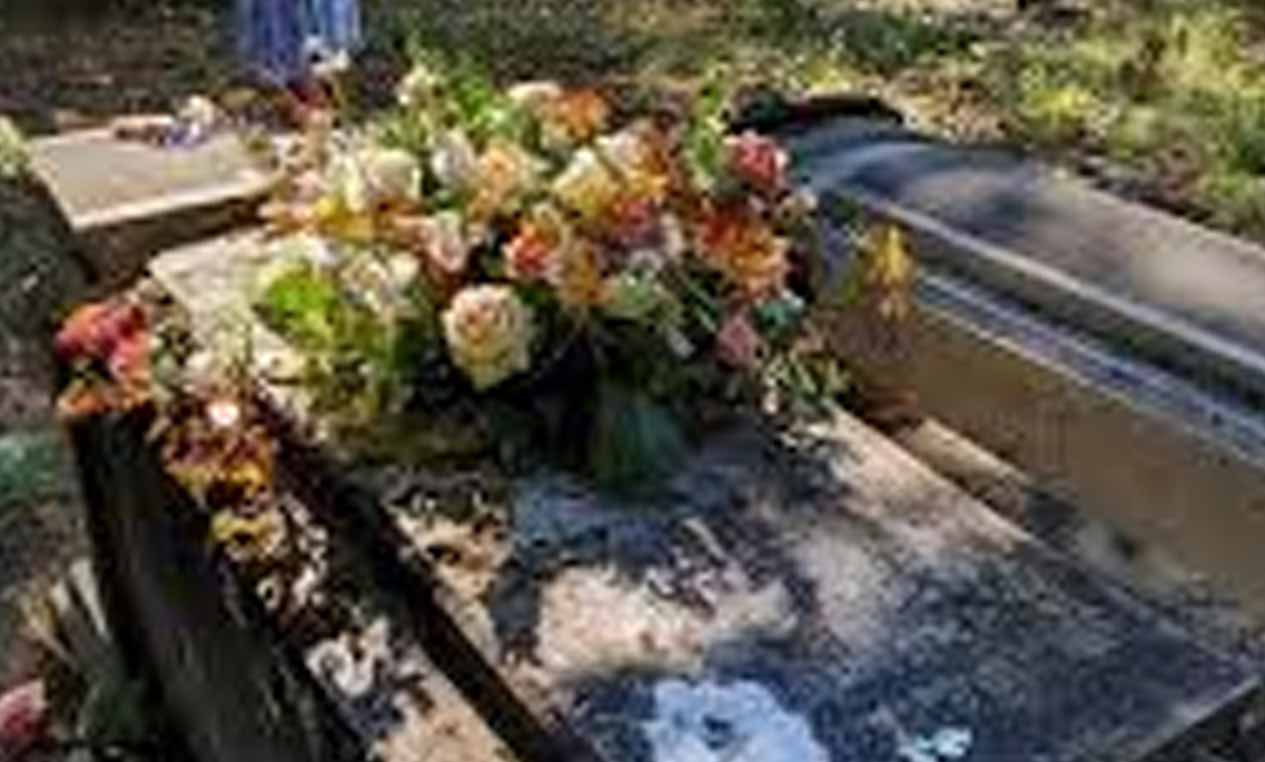
And every single year, when I arrived at her grave, there were fresh flowers already there. Always neat. Always her favorite.
White lilies.
She loved lilies. Said they smelled like clean beginnings.
The first year I noticed them, I assumed it was a mistake. Maybe the cemetery staff placed them at the wrong headstone. But they were arranged carefully, tied with a pale ribbon, resting directly beneath her name.
No one else was buried beside her. No secret husband. No family plot.
The second year, they were there again.
The third.
The fourth.
Always fresh. Never wilted. Always placed before I arrived.
I never told anyone about my visit.
No relatives. No friends. Not even my best friend, Freya, who knew almost everything about me.
At first, I tried to ignore it. Then curiosity turned into quiet fear. Who knew? And why never show themselves?
Sometimes I would glance around the cemetery, expecting someone to be watching. A figure behind a tree. A car parked too long by the gates.
But there was nothing.
Just silence. Wind moving through rows of stones. The faint hum of traffic from the road beyond the iron fence.
Part of me wondered if it was some distant relative I didn’t know about. But Mom had told me she had cut ties with most of her family when she was young. I had met exactly one aunt at the funeral, and she barely stayed long enough to hug me.
So who was it?
This year, I decided I needed answers.
Instead of arriving mid-morning like I usually did, I came earlier than usual.
The sky was still pale, the sun barely rising. It was just after 6 a.m., and the air held that damp cold that makes your breath visible. My hands trembled as I carried my own bouquet of white lilies, the petals soft and fragrant against my cheek.
I told myself I was being dramatic. That I would show up and find nothing but grass and dew and my own imagination.
But as I turned down the gravel path toward her section, I saw him.
A man stood by her grave, holding a bouquet.
He looked frozen, as if he had not expected anyone to witness his grief. He was older, maybe in his late 40s or early 50s. Tall, but slightly hunched at the shoulders, like a man carrying something far heavier than a bouquet.
Gray streaked through his dark hair. His coat was expensive, tailored well, yet the cuffs were worn, as though time had rubbed against him without mercy.
His eyes never left her name on the stone.
My heart started racing.
Something about him felt painfully familiar.
I couldn’t explain it.
It wasn’t just that he was standing at my mother’s grave. It was the shape of his jaw. The way his brow furrowed slightly, like he was fighting emotion. A strange echo of my own reflection.
I took a few steps closer, my boots crunching against gravel.
He heard me.
His shoulders stiffened.
For a second, neither of us spoke. The wind caught the ribbon around his bouquet, lifting it gently.
White lilies.
My mom’s favorite flowers.
My pulse pounded in my ears.
I had imagined this moment so many times over the years. Confronting a stranger. Demanding answers. But now that I was here, my throat felt dry.
He finally looked at me.
His eyes were blue.
So were mine.
There was shock in his expression. And something else. Guilt. Fear. Recognition.
He swallowed.
I tightened my grip on my flowers.
The cemetery felt suddenly too small, too quiet. Like the world had narrowed to just the two of us and the stone between us.
I forced myself to stand straighter.
I had spent my whole life not knowing. Not asking. Accepting silence because it was easier than tearing it open.
Not anymore.
I took another step forward until I was close enough to see the faint tremor in his hands.
“Who are you?”
My voice came out steadier than I expected.
The man stared at me as if I had asked him something impossible. His fingers tightened around the bouquet, crushing the stems slightly. For a long moment, he said nothing. His eyes searched my face in a way that made my chest tighten.
“I…” His voice cracked. He cleared his throat and tried again. “I didn’t think you’d come this early.”
That was not an answer.
“You knew I was coming?” I asked sharply.
He flinched.
“I know you come every year,” he admitted quietly.
A chill spread through me that had nothing to do with the morning air. “How?”
He looked back at my mother’s headstone, as if asking permission.
“I’ve been coming every year, too,” he said. “For five years.”
Five years.
My heart pounded so loudly I felt dizzy. “That doesn’t explain who you are.”
He finally lifted his gaze and looked at me fully. There was no denying it anymore. The resemblance was there. In his eyes. In the curve of his mouth. In the way his jaw tightened when he was trying to steady himself.
“My name is Andrew,” he said softly. “I’m your father.”
The words hit me like a physical blow.
I laughed, but there was no humor in it.
“No. That’s not possible.”
“She told you I was dead,” he replied.
“Yes,” I snapped. “She told me my father died when I was born.”
Andrew nodded slowly, pain flickering across his face. “That’s what she wanted you to believe.”
Anger surged up so fast I had to take a step back. “Why would she lie to me about something like that?”
“Because I asked her to.”
Silence stretched between us.
The wind stirred the trees, and somewhere in the distance a bird called out.
“You asked her to pretend you were dead?” My voice trembled now. “What kind of person does that?”
“The kind who thought he was doing the right thing,” he said hoarsely.
I shook my head. “You don’t get to say that and expect me to understand.”
He exhaled shakily and set the bouquet down beside mine. The lilies brushed against each other, identical.
“When your mother got pregnant, we were both 22,” he began. “We were young. I had just been accepted into law school in another state. My family…” He hesitated. “My family did not approve of Ruth. They wanted someone from their circle. Someone with money.”
I felt a flash of protectiveness.
“She didn’t need their approval.”
“I know that now,” he said quickly. “But back then, I was weak. I was scared. My father made it clear that if I stayed with her, I would lose everything. Tuition. Support. My inheritance.”
“And you chose that,” I said flatly.
He swallowed. “I told myself I would come back once I was established. Once I could give her stability. But Ruth didn’t want half promises. She said if I walked away, I had to walk away completely.”
The image of my mother standing firm, chin lifted, filled my mind. That sounded like her.
“She gave you a choice,” I murmured.
“Yes,” he admitted. “And I chose wrong.”
The honesty in his voice disarmed me for a moment.
“I tried to contact her after you were born,” he continued. “She wouldn’t respond. Then, one day, she sent me a letter.”
My breath caught. “A letter?”
He nodded. “She wrote that she had told you I died. That it would be easier for you to grow up without wondering why your father didn’t love you enough to stay.”
Tears blurred my vision. “So you let her.”
“I thought I didn’t deserve to disrupt your life,” he said. “I had already failed you both. I had no right to show up years later and confuse everything.”
“You had 23 years,” I whispered.
“I know.” His voice broke. “I watched from a distance. I made sure you were provided for when things were tight.”
I frowned. “What are you talking about?”
“There were a few times when your mother struggled financially,” he said carefully. “Hospital bills. School fees. Anonymous donations. That was me.”
Memories flashed through my mind. The mysterious scholarship my senior year of high school. The envelope with no return address when Mom was behind on rent. She had cried that night, saying, “Sometimes the universe surprises you.”
“Did she know?” I asked.
“She suspected. But we never spoke about it again.”
I pressed my hand to my mouth, overwhelmed.
My whole life felt like a carefully constructed story that was now unraveling.
“She protected you,” Andrew said gently. “From my mistakes. From my family. From resentment.”
“You don’t get to paint yourself as noble,” I shot back, though my voice lacked the sharpness it had before. “You left.”
“Yes,” he agreed. “I did. And I regret it every single day.”
We stood there in silence, two strangers bound by blood and regret.
“I don’t even know what else to say,” I said, my voice barely above a whisper.
“I do. And I have something to show you.” He hesitated, then reached into his coat pocket, pulling out a worn envelope.
“She wrote me another letter,” he said. “Before she died.”
My heart stopped.
“I received it a week after her funeral,” he continued. “She told me she was sick. She said she never told you the truth because she wanted you to grow up strong, not waiting for someone who might disappoint you again.”
That sounded exactly like her.
“She also wrote that if you ever came early one year, it meant you were ready to know.”
I stared at him. “She planned this?”
“She knew you,” he said with a sad smile. “She said you would only seek answers when you felt strong enough to handle them.”
I thought of my promise to her.
Don’t let yourself be alone in this world.
Anger still burned inside me, but beneath it was something else. Grief. Curiosity. A fragile thread of connection.
“You don’t get to step into my life as if nothing happened,” I said carefully.
“I’m not asking for that,” Andrew replied. “I’m asking for a chance to earn whatever place you decide I deserve. Even if that place is very small.”
I studied him. He looked older up close. Tired. Not the powerful villain I had imagined in my childhood anger. Just a man who made a cowardly choice and had lived with it.
“You don’t get to replace her,” I said firmly.
“Never,” he answered immediately. “Ruth was extraordinary. I lost her because I was afraid. I won’t make that mistake with you.”
Tears slid down my cheeks.
I did not wipe them away.
For so long, I had defined myself as the girl whose father died before she was born. That story shaped me. Made me resilient. Independent. Careful.
Now I had to decide who I was with the truth.
I looked down at the two bouquets of white lilies resting together against my mother’s grave.
“She loved clean beginnings,” I murmured.
Andrew nodded.
I took a slow breath.
“I’m not promising anything,” I said. “But I’m willing to talk.”
Hope flickered across his face, cautious and fragile.
“That’s more than I deserve,” he said quietly.
Maybe.
But as I stood there between my mother’s memory and the man who had been missing my whole life, I realized something.
I had kept my promise to her all these years by showing up.
Now, maybe, I could keep the other part.
Not letting myself be alone in this world anymore.
We did not leave the cemetery together.
That felt too symbolic.
Too sudden.
Instead, we stood there a while longer, talking in fragments. Small things. Safe things.
He asked what I did for a living. I told him I worked as a physical therapy assistant at a rehabilitation center downtown. He nodded with quiet pride, as if he had a right to it.
“Did you love her?” I asked suddenly.
Andrew did not hesitate. “Yes. I was just not brave enough.”
Honesty again. No excuses. No dramatic declarations.
When we finally walked toward the parking lot, we kept a respectful distance between us. Not strangers anymore, but not family either.
At his car, he paused.
“Can I call you sometime?” he asked carefully.
I considered the question. This was the moment when I could shut the door. Protect the life I had built without him.
Instead, I reached into my bag and pulled out a small notepad. I wrote my number down, then hesitated before handing it to him.
“One call,” I said. “We start there.”
His fingers brushed mine as he took the paper. They were warm, slightly rough.
“Thank you, Paige,” he said, and my name sounded unfamiliar in his voice.
I drove home with my thoughts spinning.
That night, I sat on my couch staring at the framed photo of Mom on the bookshelf. It was taken on my 17th birthday. She looked thinner already, though I had not noticed it then. Her arm was wrapped tightly around me, her smile bright and proud.
“You planned this,” I whispered to the photo.
Part of me felt betrayed. Another part felt grateful.
She had carried the burden of that secret alone. She had given me a clean story to grow up with. No divided loyalties. No half-present father.
Now the truth sat heavily in my chest.
Andrew called two days later.
I let it ring once before answering.
“Hi,” he said, his voice tentative.
“Hi.”
We met at a small coffee shop halfway between our neighborhoods. Neutral ground.
He arrived early. I could tell by the untouched cup in front of him that he had been sitting there rehearsing.
Over the next hour, we spoke more honestly than I expected.
He told me about his work as a corporate attorney. About the divorce he went through ten years ago. No other children. He admitted that he had thrown himself into work for years because it was easier than facing regret.
“I kept thinking success would quiet the guilt,” he confessed. “It didn’t.”
I listened. I asked questions. Hard ones.
“Did your family know about me?”
“My mother did,” he said. “She passed away three years ago. She regretted how she pressured me. My father never acknowledged it.”
I studied his face as he spoke. I searched for arrogance. For selfishness. What I found instead was weariness and a careful effort not to push too far.
“I’m angry,” I told him plainly.
“You should be.”
“I don’t know how to fit you into my life.”
“You don’t have to rush that,” he replied. “If all I ever get is coffee once a month, I will take it.”
The simplicity of that answer softened something inside me.
Over the following weeks, we met again. Short lunches. A walk in the park. Conversations that felt awkward at first, then gradually less so.
He never tried to rewrite history. He never criticized my mother. In fact, he spoke of her with a quiet reverence that surprised me.
“She was stronger than I ever was,” he said once.
I began to see him not as the villain of my childhood imagination, but as a flawed man who made a fearful choice and paid for it in silence.
One evening, after our fourth meeting, I brought out the box of Mom’s old letters and photographs from my closet.
I had avoided going through them since her death.
I sat on the floor and opened them slowly.
There were no dramatic confessions. No hidden anger.
But tucked between two photographs, I found a sealed envelope with my name written in her familiar handwriting.
My hands trembled as I opened it.
Paige,
If you are reading this, it means you found your way to the truth. I never lied to hurt you. I lied to protect your heart while it was still small. Your father loved you in the only broken way he knew how. I needed you to grow up believing you were fully chosen.
If he is standing in front of you now, it means he has finally chosen courage.
Do not carry my fear into your future. Build something better.
Love always,
Mom
Tears streamed down my face, but they were different from the ones I had cried at her grave. These felt lighter. Like release.
The next time I saw Andrew, I handed him the letter.
He read it in silence.
When he finished, his eyes were wet.
“She always believed people could grow,” I said softly.
“She believed that about me when I didn’t,” he replied.
I took a steady breath.
“I’m not promising perfection,” I told him. “But I’m willing to try.”
He nodded, emotion tightening his voice. “That’s all I’m asking.”
Our relationship did not transform overnight.
There were awkward pauses. Misunderstandings. Moments when old resentment flared unexpectedly.
But there were also shared laughs.
Stories about Mom that filled in the missing pieces of her younger years. A gradual sense that I was no longer carrying my history alone.
On the next anniversary of her death, we went to the cemetery together.
This time, there was no shock. No confrontation.
Just two bouquets of white lilies placed side by side.
As we stood there, I felt the weight of the past settle into something steadier.
“I kept my promise,” I murmured.
Andrew glanced at me.
“What promise?”
I looked at my mother’s name carved in stone.
“She told me not to let myself be alone in this world.”
He did not respond, but he did not need to.
For the first time in my life, the space beside me was not a reminder of what I lacked.
It was a quiet promise of what could still be built.
 admin
admin