
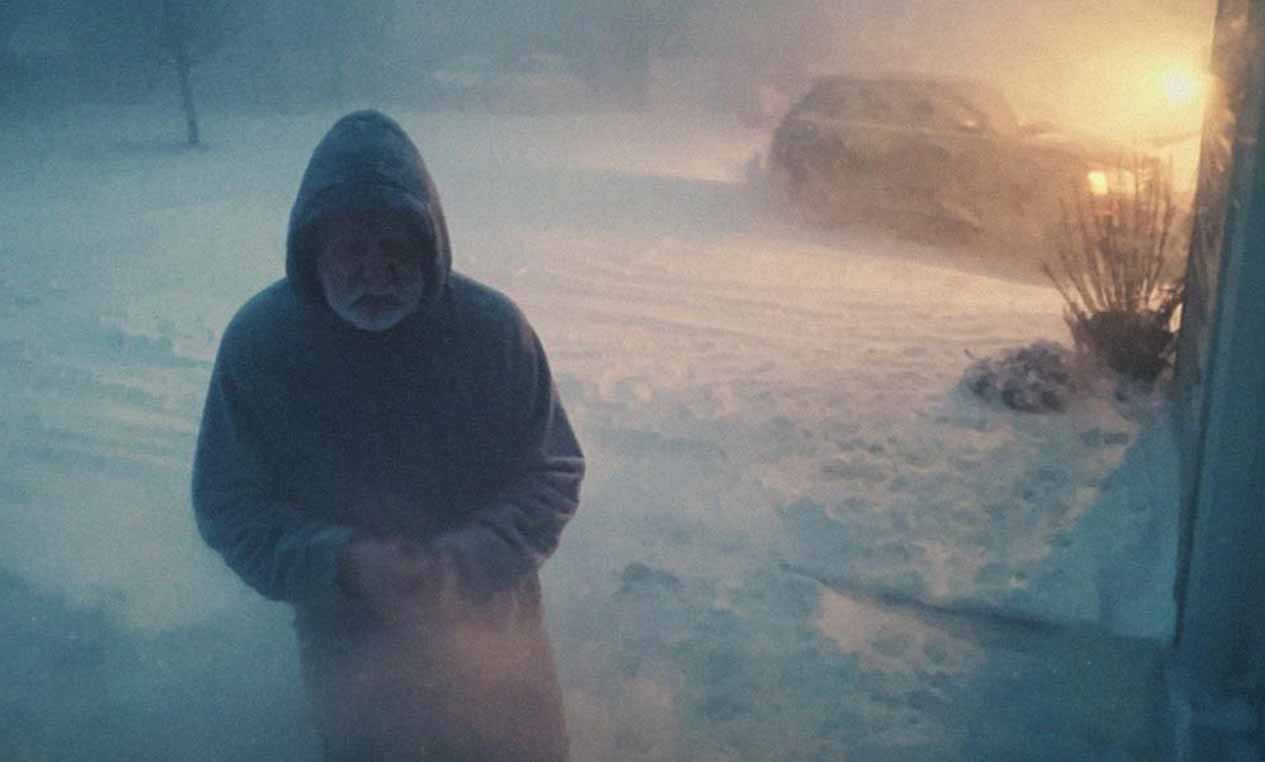
That night, the blizzard came fast and violent, the kind of storm that erases the world in minutes. Snow blew sideways across the street, and the wind rattled my garage door hard enough to make me think it might come off its tracks.
I was halfway through closing up when I saw him.
A man stood near the edge of the road, barely visible through the white haze. He wasn’t moving much, just standing there with his arms wrapped around himself, wearing a coat that was way too thin for weather like this. Snow clung to his shoulders and hair like he’d been out there for a while.
I could have shut the garage and pretended I didn’t notice.
Instead, I walked toward him.
“You okay?” I called over the wind.
He turned slowly. His face was pale, and his lips were nearly blue from the cold.
“No,” he said honestly. “I’m not.”
His voice was unusually calm.
“I don’t have anywhere to go tonight,” he continued. “I won’t ask for money or cause trouble. I just need to get out of the wind.”
I hesitated for a moment, my mind racing through all the reasons this was a bad idea.
I was 28 and barely holding things together. This house wasn’t fancy, but it was the only thing in my life that felt solid. My dad left it to me when he passed, along with a mortgage I was still struggling to manage. I worked long hours, skipped repairs I couldn’t afford, and lived with the constant fear that one bad month could take it all away.
Letting a stranger onto my property felt reckless.
But leaving him in that storm felt worse.
Because the truth is, I knew what it felt like to stand outside with nowhere certain to go.
After my dad died, there were months when I barely kept this place. I picked up odd jobs wherever I could — hauling scrap, fixing fences, cleaning out storage units — anything that paid cash by the end of the day. There were nights I slept in my truck because I couldn’t afford the heating bill.
I knew the humiliation of needing help and not asking.
And I remembered how small acts, like a hot coffee from a gas station clerk who didn’t charge me, and a neighbor who let me park in his driveway instead of the street, had kept me going when my pride was hanging by a thread.
Standing there in the wind, looking at this man shivering in a coat too thin for the storm, I didn’t just see a stranger.
I saw someone who might be one bad season away from losing everything.
And I couldn’t be the kind of man who ignored that.
“You can sleep in the garage,” I said finally. “It’s not heated, but it’s better than this.”
For a second, he just stared at me. Then his shoulders sagged in relief.
“Thank you,” he said quietly. “You have no idea what that means.”
“I’m Stephen.”
“Richard.”
I lifted the garage door and let him inside. The space smelled like oil and cold cement. I grabbed an old blanket from the shelf and the thermos of tea I’d brought home from work earlier.
“Wrap up,” I told him, handing both over. “Tea’s still warm.”
He accepted them carefully, like they were fragile gifts instead of worn-out things I’d almost thrown away.
“How long have you lived here?” he asked, glancing around the garage.
“Three years.”
He nodded slowly, his eyes lingering on the walls in a way that seemed strange to me.
“It’s a strong house,” he said.
I gave a small laugh. “It leaks when it rains.”
“Still,” he murmured. “It’s stood through worse.”
There was something in the way he said it that made me look at him again.
Up close, he didn’t look like someone who had always been homeless.
His beard was trimmed, even if it had grown out some, his posture was straight, not hunched as you’d expect, and his words were deliberate and thoughtful.
“You from around here?” I asked.
He hesitated for just a moment. “I was.”
The wind slammed against the garage door hard, making us both flinch at the sound.
He took a sip of tea and closed his eyes briefly, like he was savoring the warmth.
“I lost my wife,” he said suddenly.
“I’m sorry,” I replied, not knowing what else to say.
He nodded once, his eyes still closed. “After she died, the house didn’t feel like a house anymore. It felt like a museum.”
I didn’t know what to say to that, so I just stood there and listened.
“Grief makes you wander,” he continued quietly. “It makes you question things you once took for granted.”
“Like what?” I asked.
“Like whether kindness still exists when no one knows your name.”
The way he said it made me shift uncomfortably. There was a depth to his words that hit harder than I expected.
“Well,” I said, trying to keep it light, “you’re safe tonight.”
He looked at me for a long moment, studying my face in the dim light of the garage.
“Thank you for not letting fear answer first,” he said.
I didn’t know how to respond to that, so I just nodded and told him to get some rest. I locked the door to the house behind me and went to bed, but I didn’t sleep well at all.
By morning, the storm had passed completely. The sky was clear and bright.
I went to the garage expecting to find something wrong. Instead, it was spotless.
The blanket was folded neatly on the chair, and the thermos had been rinsed and set upside down on my workbench to dry. There was no trash anywhere and no sign of anyone rummaging through my things.
And Richard? He was gone.
Around noon, my phone rang. It was an unknown number.
“Hello?”
“Is this Stephen?” a woman asked.
“Yes.”
“This is Cynthia from First National Bank. Could you please come in? We have something for you. There’s been… an unusual activity on your account.”
My heart skipped a beat.
“What kind of activity?” I asked.
“It’s best we discuss it in person, Mr. Stephen.”
I hung up and just stared at the wall.
Unusual activity? I thought. What could it be?
My mind went straight to Richard, and I felt heat in my cheeks. I felt angry.
Of course. I’d been naïve, hadn’t I?
I’d let a complete stranger onto my property. Maybe he’d taken mail from the box while I was asleep. Maybe he’d seen something with my account number on it, some piece of paper I’d left lying around.
I drove to the bank as my heart pounded against my chest, preparing myself for the worst news possible.
Cynthia met me in a small office near the back. She looked serious but not alarmed, which confused me and made my anxiety worse.
“Stephen,” she said gently, sitting down across from me. “A very large payment was made toward your mortgage last night.”
I looked at her with wide eyes. “What?”
“Your mortgage,” she repeated slowly. “It’s been paid in full.”
The words didn’t register in my brain at first.
“That’s not possible,” I said.
“It was authorized and verified,” she said, her expression soft.
I stared at her, waiting for the part where she told me it was fraud, that I was somehow in trouble, and that this was all a mistake.
Instead, she slid an envelope across the desk toward me.
“The individual who made the payment asked us to give you this.”
My hands started shaking as I reached for it.
“Richard?” I whispered.
She gave a small nod, a slight smile touching her lips.
I opened the envelope with trembling fingers.
Inside was a letter written in careful handwriting and a cashier’s check for an amount that made my head spin.
I unfolded the letter first.
Stephen,
You welcomed me into your garage without asking who I was or what I could give you. That kind of generosity is rare in this world.
I once owned your house. My wife and I raised our children there. We celebrated birthdays in that kitchen. We planted the oak tree in the front yard when our daughter was born.
After my wife passed away last year, I found myself driving past the house more often than I care to admit. I could not bring myself to knock on the door. I did not want to disturb the life that had replaced ours.
Last night, I stood outside during the storm, unsure whether I still believed in the goodness of strangers.
You answered that question.
I am not without means. I sold my business years ago. The money has sat untouched while I wandered through my grief, trying to find meaning again.
Consider the mortgage payment my way of honoring the home that once sheltered my family—and the young man who showed me that kindness still lives within its walls.
The additional funds are for repairs, security, or whatever brings you peace of mind.
Thank you for letting me come home one last time.
And thank you for not letting fear answer first.
Richard
By the time I finished reading, my vision had blurred with tears I didn’t even realize were falling.
I couldn’t believe it.
“He used to own my house,” I said faintly, looking up at Cynthia.
She nodded, her own eyes looking a bit watery. “He mentioned it meant a great deal to him.”
All at once, the night replayed in my head. I saw him touching the walls like they were precious, asking how long I’d lived there, calling it a strong house even when I joked about the leaks.
I drove home in a complete daze, my mind spinning with everything that had just happened.
When I pulled into the driveway, I didn’t get out right away. I just sat there in my car, staring at the house like it belonged to someone else entirely.
It was now paid in full.
For three years, that mortgage had been the shadow hanging over every single decision I made. Every overtime shift I took. Every repair I postponed because I couldn’t afford it. Every time I told myself I couldn’t buy something simple because the payment was due.
Now it was gone, just like that.
I stepped out of the car and walked slowly to the garage, my legs feeling strange and unsteady. The cold cement walls looked exactly the same as always, but they felt completely different now.
I ran my hand along the surface where Richard had stood the night before, trying to imagine what he’d seen when he looked at these walls.
I thought about how quickly I’d assumed the worst when the bank called. How easily I’d believed that my one act of kindness had been punished and that I’d been taken advantage of.
I’d almost let fear rewrite the entire story.
Instead, kindness had rewritten it for me.
I don’t know where Richard went after that night. Maybe he kept driving around, visiting other places from his past. Or maybe he found somewhere new to stand still and remember.
But I know this much: that night, I thought I was saving a stranger from a deadly storm.
Turns out, he was saving me from something, too.
From debt, yes.
But also from becoming the kind of man who shuts the door without looking twice and who lets fear make all his decisions.
Sometimes, I still stand in the driveway and look at this house — the oak tree in front that Richard planted decades ago, the worn steps, and the garage door that still rattles in high wind.
It really is a strong house.
It held his memories for all those years.
Now it holds mine.
And every time a storm rolls in, I remember what he said to me that night.
Kindness matters more than people think.
So let me ask you something. If a stranger showed up at your door during the worst blizzard of the year, desperate and freezing, would you open it? Or would you let fear answer first?
 admin
admin