
At 62, Eleanor had learned to measure her days by the quiet. The mornings were slow and predictable, the kind that unfolded without urgency. She woke up before the sun out of habit, brewed a single cup of tea, and sat at the small kitchen table facing the window.
Outside, the maple tree she had planted decades ago swayed gently, its branches thinner now but still faithful.
Teaching had once filled every corner of her life.
For 37 years, Eleanor had stood at the front of classrooms, her voice shaping lessons, her eyes tracking faces that changed every semester.
Retired for nearly four years now, she sometimes struggled to remember how loud her world used to be. The bells, the chatter, the endless rhythm of questions and answers. Time had softened the edges of those memories, turning most of them into a blur of faces and names that drifted in and out of reach.
But not all of them faded.
There was one evening she still returned to, uninvited and vivid, no matter how many years passed. It came to her most often when the house was quiet, when the light slanted just right through the windows, or when rain tapped against the glass like a careful knock.
Back then, she had already been teaching for decades. She knew the patterns of students well. She could tell who was confident, who was struggling, and who was trying to disappear.
Chace had belonged to the last group.
He was quiet in a way that did not ask for attention.
At 17, he sat near the back of the classroom, shoulders slightly hunched, eyes down more often than not. He completed his work, but never with confidence.
His grades hovered in the middle, never alarming, never impressive. He was the kind of student who could easily be overlooked, and Eleanor knew that frightened her more than poor performance ever did.
She noticed how he lingered after class. Not every day, but often enough. He would wait until the room emptied, until chairs scraped and laughter faded down the hallway.
Sometimes he pretended to organize his backpack.
Other times, he just sat there, staring at his desk as if hoping for instructions that never came.
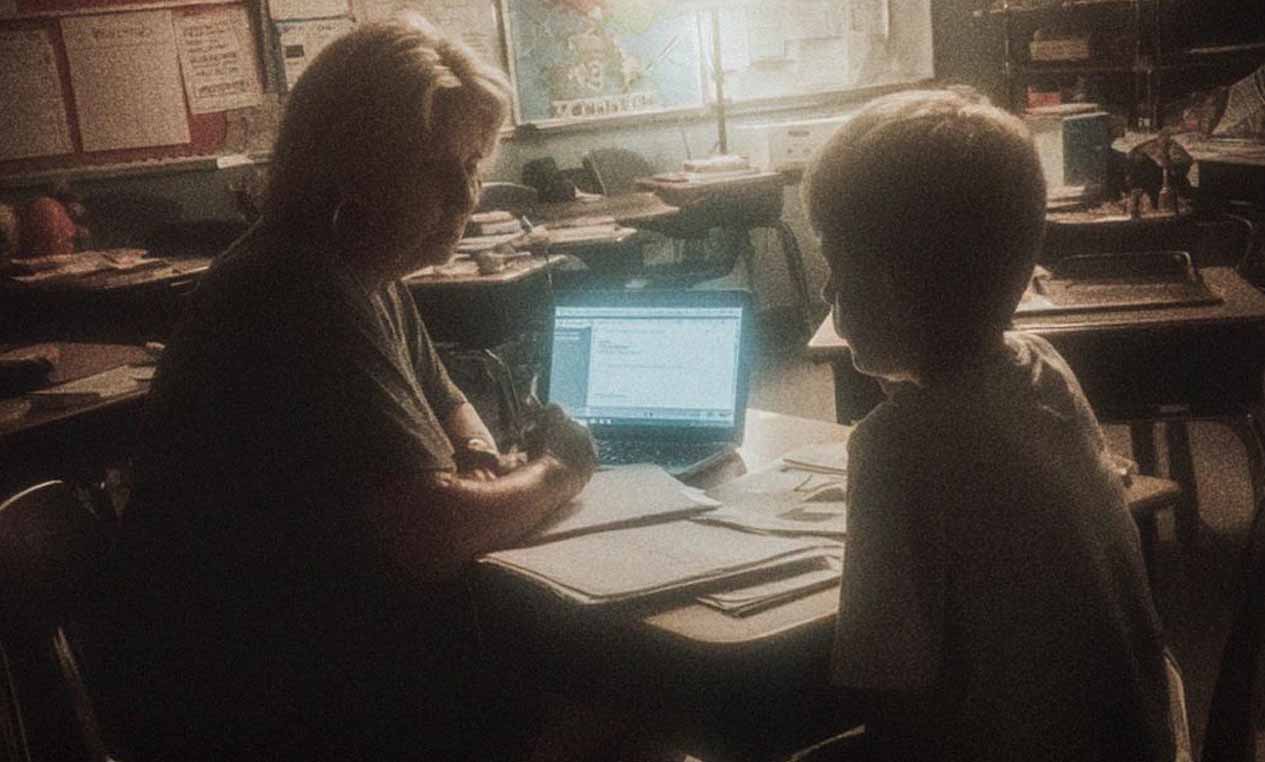
That evening had been unremarkable at first. The sun was already low, casting long shadows across the classroom floor. Eleanor gathered her papers slowly, her joints stiff, her mind already drifting toward home. When she looked up, she saw him still there.
“Chace,” she said gently, breaking the silence. He startled, as if he had not realized she was still in the room.
“Yes, ma’am?”
His voice was soft, careful.
She asked if he needed help with the material. He hesitated, then nodded. She pulled a chair beside his desk and stayed with him. They went over notes and reviewed problems he had struggled with. He listened closely, nodding, asking questions that surprised her with their depth.
At some point, the work gave way to something else. His answers slowed. His hands trembled slightly as he gripped his pencil. Eleanor waited, letting the silence stretch.
Experience had taught her that silence could be an invitation.
He finally spoke about home. About fear. About feeling invisible.
The words came haltingly at first, then faster, as if once the door opened, it could not be closed again. He talked about nights spent awake, about never knowing what version of his parents he would come home to. About feeling like no one noticed whether he succeeded or failed.
Eleanor listened.
She did not interrupt.
She had learned long ago that listening was sometimes the most important lesson she could offer.
When he finished, his eyes were fixed on the desk, his face flushed with embarrassment. Eleanor felt a familiar ache in her chest, the kind that came from recognizing pain she could not fix.
She told him he mattered.
She said it plainly, without theatrics. She walked him to the door when the building was nearly empty, the halls echoing with their footsteps. She reminded him that his presence in the classroom was seen, that his struggles were real, and that they did not define his worth.
Then life moved on.
The school year ended.
Another began. Students graduated, transferred, disappeared into futures Eleanor could only imagine. Chace remained for a while, quieter but steadier. Then he was gone too, another name in the records, another face filed away in memory.
Years passed.
Eleanor continued teaching until retirement finally forced her to slow down. The decision had been practical, not emotional. Her body tired more easily, and the energy she once drew from the classroom began to wane. On her last day, colleagues hugged her, students applauded, and she smiled until her cheeks ached.
After that, life became quieter.
She moved into a smaller house on the edge of town, close enough to walk to the market, far enough to hear the rain when it fell. Her days settled into routines. Gardening. Reading. Occasional lunches with former coworkers who still spoke in the shorthand of lesson plans and staff meetings.
Faces and names from the classroom slowly faded into memory. Eleanor accepted this as natural, even necessary. She told herself that she had given what she could and that the rest belonged to time.
Still, there were moments when she wondered.
She thought about the students who had stayed late, who had needed more than she could offer. She hoped they had found their footing somewhere beyond her reach.
On one rainy afternoon, Eleanor was in the living room, folding laundry while the radio murmured in the background. The sky outside was a dull gray, the kind that pressed low and close. She was not expecting anyone.
The knock startled her.
It was firm but hesitant, as if the person on the other side was reconsidering the decision even as their hand fell away. Eleanor set the laundry aside and walked to the door, her knees stiff, her heart oddly alert.
When she opened it, a tall man stood there.
He looked nervous, shifting his weight from one foot to the other. Rain darkened the shoulders of his jacket, and his hair was damp. For a moment, Eleanor just stared, trying to place him. There was something familiar in the slope of his shoulders, in the way his hands fidgeted.
Then it clicked.
That shy smile from years ago.
Recognition settled over her slowly, like a memory rising from deep water. The boy in the back row was gone, replaced by a young man, broader, taller, but unmistakably the same at his core.
She had opened the door and recognized his face, but in his hands, he was holding a box.
Eleanor’s breath caught as she took it in, the rain, the stranger who was not a stranger at all, and the quiet weight of the past standing on her doorstep, waiting to be acknowledged.
She stepped back to let him inside, the door closing softly behind them as rain continued to fall. The sound filled the brief silence between them, a steady rhythm that seemed to give him time to breathe.
“I was not sure you would remember me,” he said at last, his voice deeper than she remembered but still careful.
“I hoped you might.”
“I do,” Eleanor replied. “It just took me a second.”
She gestured toward the living room. He followed, holding the box as if it were fragile. Once they were seated, she studied him more closely. The nervous energy was still there, though tempered now by something steadier. His hands rested on his knees, then moved back to the box again.
“You look well,” she said. “Older, of course. But well.”
He smiled, a little embarrassed. “I am 29 now. It feels strange to say that out loud.”
She nodded. “It feels strange to hear it.”
For a moment, neither of them spoke.
Eleanor realized she was waiting, and so was he. The box sat between them like a third presence in the room.
“I carried that with me for a long time,” Chace said finally. “I always knew where it was. I just did not know when I would be ready to bring it here.”
“What is it?” she asked gently.
He exhaled and placed the box on the coffee table. “It is for you. Or rather, it is something I wanted you to see.”
He lifted the lid.
Inside were papers, neatly stacked.
A few notebooks. A worn folder with frayed edges. Eleanor leaned forward, recognition dawning before she could stop it.
“That is my handwriting,” she said quietly.
Chace nodded. “You gave me those notes. That evening, you stayed late with me and rewrote the lesson in a way I could understand. I kept them.”
Eleanor felt her throat tighten. She remembered the notes vaguely, not thinking much of them at the time. She had done it often for many students.
“There is more,” he said.
He reached into the box and pulled out a folded sheet of paper. It was yellowed now, creased from being opened and closed too many times. Eleanor recognized it immediately.
“I wrote that after graduation,” Chace said. “I never sent it. I did not think you would want it. Or that it would matter.”
She unfolded the paper with trembling fingers. The words were uneven, the ink faded, but legible. He had written of that evening, of sitting alone long after everyone had left, of fear and feeling invisible. He described how she stayed with him, helped him study, and listened.
At the bottom, he had written one sentence that made her eyes blur.
“You told me I mattered, and I believed you.”
Eleanor pressed the paper to her chest, unable to speak for a moment. She had told herself, for years, that teachers rarely knew the impact they made. She had accepted that truth as a comfort. Now it felt like a weight.
“I carried this through college,” Chace continued. “Through nights when I wanted to quit. Through jobs that did not work out. Every time I felt like disappearing again, I read it.”
She looked up at him. “You went to college.”
“I did,” he said. “It took me longer than most. I worked and studied and failed more than once. But I finished.”
She smiled through tears.
“I am glad.”
“There is one more thing,” he said.
From the bottom of the box, he lifted a framed photograph. It showed a modest office, a desk with two chairs, and a sign on the wall that read Student Support Services. Chace stood in the picture, younger than he was now but unmistakably himself.
“I work at a community college,” he said. “I help students who struggle. Not just with grades. With everything else.”
Eleanor’s breath caught. “You became the person you needed.”
He nodded.
“Because you were that person for me.”
Silence settled again, heavier this time, but not uncomfortable. Eleanor felt something inside her shift, something she had carried unknowingly since retirement. A quiet doubt she had never fully named.
“I spent years wondering if any of it mattered,” she admitted. “If staying late, listening, caring made any difference once students walked out those doors.”
Chace met her gaze. “It did. It still does.”
They talked for a long time after that, moving easily between his life and his work, and the students who reflected parts of his younger self. Eleanor shared stories from her years in the classroom, recalling the faces she still carried with her and those that time had quietly taken away.
At one point, Eleanor laughed softly.
“I was so tired that night. I almost told you to go home.”
“I am glad you did not,” he said.
The rain eased outside, leaving the world washed clean. When it was time for him to leave, Chace stood and picked up the empty box.
“You can keep the notes,” Eleanor said. “I think they belong with you.”
He shook his head. “They belong here now.”
At the door, he hesitated. “Thank you,” he said.
“For opening the door. Then and now.”
Eleanor watched him walk down the path, taller than she remembered, steadier too. When the door closed, the house felt different. Fuller.
She returned to the living room and sat quietly, the letter resting on her lap. For the first time since retiring, the silence did not feel empty.
It felt earned.
 admin
admin