
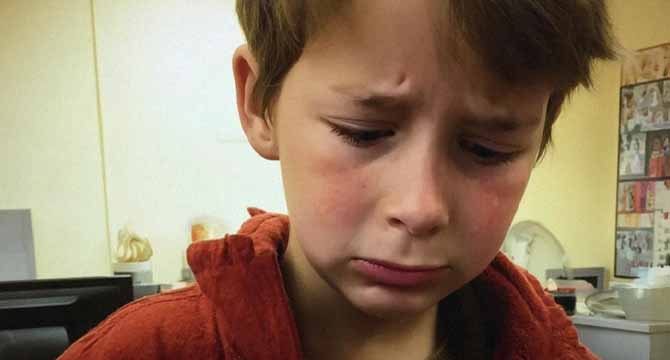
You don’t expect the biggest moment of your life to happen before homeroom. I was trying to make it to school without being late when a man collapsed right in front of me. Rich people walked past as if he were invisible. I almost did too. But the second I reached for his hand, everything changed.
I still remember the sound his body made when it hit the sidewalk. A thud, not loud, not dramatic — just wrong.
I was walking through the rich part of town, like I always did when I took the long route to school. My sneakers had holes, my hoodie was two sizes too small, and I had this dented cereal box tucked tight to my chest like it was treasure.
It was a treasure to me — generic cornflakes I’d snagged from the food bank the night before.
That’s when I saw him.
An old man wearing a nice suit, with neat hair. He just dropped like someone cut his strings. Collapsed right there on the spotless sidewalk, twitching, his briefcase flying open and papers fluttering like scared birds.
I froze.
And then I watched.
One woman in heels stepped over him without blinking. Another guy in a Bluetooth headset veered slightly to avoid him, but didn’t stop. No one did. To them, everything seemed normal; it was like he wasn’t even there. I couldn’t believe it.
I dropped my cereal.
“Hey! Mister?!” I ran to him. His face was twisted, one side drooping, eyes wide with pure fear.
Stroke.
I’d seen it before. It hit my grandma. She didn’t make it.
I fumbled out my dad’s old, cracked phone — screen barely responsive. “911! I need help! A man’s on the ground — he’s shaking. I think it’s a stroke. Please come fast!”
He looked at me like I was the only person left in the world. I grabbed his hand. It was cold. “I’m right here, okay? You’re not alone.”
He couldn’t talk, so I did. I told him about school. Math, video games, just enough to keep him from slipping.
The ambulance came ten minutes later.
I grabbed my cereal, ran to school, and told no one.
Three weeks later, I got called to the principal’s office.
That’s never good news when you’re 11 and usually late to school. I figured I was in trouble again for something dumb — maybe the cereal box incident finally caught up to me. I shuffled in, head down, already crafting some kind of apology.
But then I saw him.
Sitting in the corner in a tailored suit, looking freshly shaved and painfully out of place, was the man from the sidewalk. Mr. William.
Alive.
He didn’t smile, didn’t say “thank you” or jump up and hug me like they do in movies. His face looked like it was carved from stone — but the kind that was about to crack.
The principal said, “Danny, Mr. William would like to speak with you,” and quietly stepped out, closing the door behind him. The silence felt heavy. Then he reached into his coat, pulled out a photo, and slid it across the desk.
In the photo was a young woman with long dark hair and a big smile. The kind of smile that said she used to laugh a lot.
My throat closed up. “That’s… my mom,” I whispered.
“I know,” he said. His voice broke like something inside him snapped. “That’s my daughter. Jennifer.”
Everything tilted sideways.
My mom had left when I was three. Dad never said much — just that she made mistakes. That she “left us.” But now, this man, this stranger — was saying…
“I disowned her,” William said, his face twisted with guilt. “She got pregnant at 19. I was furious. I Cut her off, told her she was dead to me. When she died last year… I didn’t even know. I found out through an obituary.”
He wiped his eyes with shaking hands.
“I hired a private investigator. Found out everything…about you, your dad, how you walk an extra mile just to save a couple bucks on cereal. That morning… I was walking to your building. I was 50 feet away when I collapsed. And then you…the grandson I abandoned…saved me.”
I could barely breathe. “You… you knew who I was?” I asked.
He nodded slowly. “Not when you took my hand. But I’d seen you before. Weeks earlier and walked right past you. Didn’t even see you.”
I looked at him — this man with everything — and saw only the helpless figure from the sidewalk.
“I stopped because no one deserves to die alone,” I said quietly. “Not even people who make mistakes.”
William didn’t say anything after that. Just sat there, shoulders trembling, a man cracked straight down the middle.
And then… he broke.
Tears streamed down his face in raw, ugly waves. He covered his mouth, choking back sobs, but it was too late. The dam was gone. “I should’ve been there,” he whispered. “When she gave birth. When she cried herself to sleep. When she died. I was too proud. Too stupid.”
I didn’t know what to say. What do you say to a man who abandoned your mom and never even knew you existed until it was too late?
But I didn’t hate him. I just hurt.
I nodded, slowly. “You can’t fix the past,” I said. “But… maybe you can show up now.”
Six months later, my life looked different.
My dad and I didn’t suddenly strike gold or anything. We didn’t move into some sprawling mansion. But we did move. Into a little house with peeling paint and a lemon tree in the yard. The rent was covered, mostly by someone who insisted it was the least he could do.
William never tried to play the hero, and he never pretended the past didn’t happen. He just… showed up.
Every Sunday.
Rain or shine, suit or sweatpants, he’d knock on the door with that same uncertain look in his eyes, like he wasn’t sure if he deserved to be let in. But I always opened the door.
He’d bring donuts or board games. Once, he brought a dusty chess set and said, “Let me teach you how to see three moves ahead.”
“You trying to turn me into a genius or something?” I teased.
He chuckled. “Just trying to keep up with my grandson.”
We started slow. Pawns, rooks, bad jokes. But over time, he stopped being the man on the sidewalk. He started being someone real. Someone trying.
He’d ask about school, help with math, and listen to me talk about video games he didn’t understand. I never said it out loud, but I think part of him was listening for echoes of my mom.
He missed her. You could see it in the way he looked at me, like I was a second chance he didn’t know he’d get.
And me? I kept the cereal box. That old, dented box I dropped when I ran to help him. It sits on my desk, right next to the chessboard. People ask why I keep trash around. I just smile.
“It’s not trash,” I say. “It’s a reminder.”
That day, I had nothing to offer. Just a beat-up phone, a broken cereal box, and a choice. Everyone else walked past, but I stopped.
Not because I knew he was family. Not because I thought I’d get anything in return. But because someone was dying, and nobody should die alone.
William can’t erase the past.
He can’t bring my mom back or undo the years we lived with too little. But he can sit across from me on Sundays, look me in the eye, and stay.
That means something.
Because people aren’t just their worst mistakes. They’re also their last chances.
And sometimes, the person who saves you is the one you failed the most.
 admin
admin